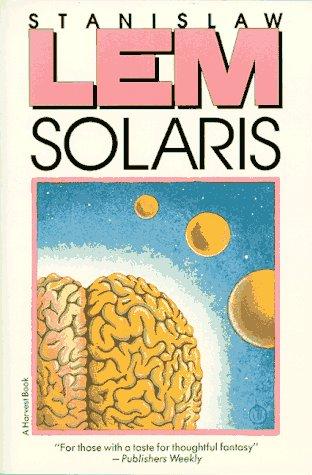
I’d seen the Soderbergh film years before I ever picked up the novel, and I want to say clearly, before anything else, that the film is not the book, in the way that matters most, the film doesn’t show you a single wave of the ocean, doesn’t dwell in the sheer alienness of the thing. It’s love in outer space, as one reader put it, borrowing Lem’s own dismissal of it. Solaris the novel is not a love story wearing a science fiction costume. It’s a first-contact story where contact never actually happens, and where the not-happening is the entire point.
The setup: a research station orbits Solaris, a planet whose entire surface is a single sentient ocean, one that’s been studied for the better part of a century by a whole discipline, “solaristics,” without anyone getting closer to understanding what it wants or whether “wants” is even the right verb. When Kris Kelvin arrives to join the station’s skeleton crew, he finds one scientist dead by his own hand and the others unwilling to explain why, and then, waking up one morning, finds his wife in his quarters. His wife who has been dead for years. Not a ghost, not an illusion, a fully physical, breathing person, generated by the ocean from something extracted out of Kelvin’s own memory and guilt.
This is where the book is doing its most interesting work and where the film, understandably, has to compress: the “visitor,” as they’re called, isn’t a monster and isn’t quite a person either, she knows she’s not the original, she can’t leave the room for more than a few minutes without a violent compulsion pulling her back, and Kelvin’s relationship with her becomes a genuinely uncomfortable meditation on what makes a person a person, whether a perfect copy who suffers is entitled to the same moral weight as the thing it copied. One reader called this “the heart of the heart of the hackneyed scifi chestnut,” and I think that’s exactly right, Lem takes a question a lesser book would treat as a twist and just sits in it, uncomfortably, for two hundred pages.
The cost of that sitting is real, though, and it’s the thing that splits opinion hardest. Large stretches of the book are Kelvin in the station library reading decades of solaristics scholarship, competing theories about what the ocean’s structures mean, whether it’s trying to communicate or merely reacting, whether it might in fact be a kind of God, an imperfect, limited, possibly suffering one, per a passage that stuck with more than a few readers as the book’s genuine philosophical core. This is fascinating if you’re the kind of reader who wants the alien to stay alien, unresolved, permanently outside human categories. If you came in wanting plot momentum, these sections read like an encyclopedia grinding the story to a halt, and a real contingent of readers describe exactly that, the pace as excruciating, the characters as flat instruments for delivering theory.
I landed at four stars because I think the slowness is doing real work, not padding, the book is deliberately refusing you the satisfaction of an ocean that finally explains itself, the same way Kelvin never gets an explanation he can actually use. But I understand completely why someone picks this up expecting a first-contact thriller and puts it down feeling cheated, this is closer to philosophy with a plot loosely wrapped around it than the other way around. If you’ve only seen a film version, either one, you haven’t actually met this book yet, and it’s colder and stranger and less resolved than either adaptation lets on.