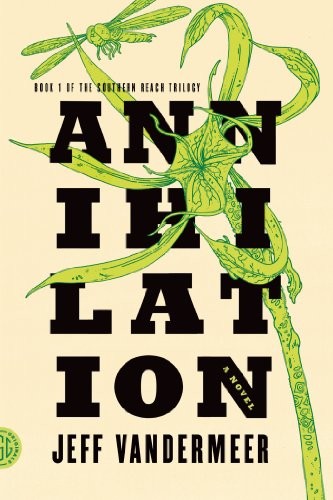
Read this one in a single sitting, which I think is honestly the correct way to take it, the dread builds cumulatively and if you put it down for a few days between chapters I suspect some of the low creeping wrongness evaporates. Four women, referred to only by their function, a biologist, a psychologist, a surveyor, an anthropologist, go into Area X, a mysterious quarantined region that used to be an ordinary stretch of coastline, as the twelfth expedition of its kind. The previous eleven did not go well, in ways the book only gestures at rather than explains.
The biologist narrates, and she is, by her own admission, someone who studies systems without ever quite participating in them, her marriage included, and that particular kind of detachment turns out to be exactly the right lens for what Area X does to a person’s sense of self. I saw someone describe the tone as sitting somewhere between Lovecraft and House of Leaves, and someone else clocked the Tarkovsky Stalker resemblance almost immediately, both of which are right, but neither fully accounts for how much of this book is actually about ecology, actually about watching a tide pool closely enough that the watching becomes its own kind of horror.
Here’s the thing that separates the people who love this from the people who bounce off it hard, and both camps are loud: VanderMeer gives you exactly as much information as the plot requires and not one fact more. There’s a tower that might be a tunnel, there’s writing on the walls made of something that might once have been alive, there’s a lighthouse with a very bad history, and none of it resolves into an explanation, not in this book, possibly not ever depending how you feel about the sequels. One reader nailed the frustration precisely, comparing it to “the prog rock of novels, full of moody intonations and baroque textures that never actually resolve into anything particularly compelling,” and I laughed reading that because I disagree completely but I understand exactly what they mean.
What kept surprising me is how much genuine tenderness is buried in the dread. There’s a line, something like wondering if it was the remnants of the scientist in her trying to apply logic when all that mattered anymore was survival, that stopped me cold on a first read, the kind of sentence that justifies the slow parts around it. And the ecological horror, less about monsters than about a landscape that’s actively, patiently rewriting the people inside it, is doing something a lot of Lovecraft pastiche reaches for and rarely earns.
I won’t pretend the backlash is unfair. If you go in wanting the mystery box to open, wanting Lost-style answers by the last page, you are going to be furious, several readers described the ending as a fever-dream monologue and meant it as a real complaint, not praise. This book asks you to sit in not-knowing as a genre in itself, and if that’s not your genre, it will feel like four hundred pages of filler stretched across a much shorter idea.
Five stars from me, and I recognize that’s partly a temperament thing, I like being unsettled more than I like being answered. If you’ve read anything by VanderMeer before and liked the specific flavor of biological wrongness he does, you already know if this is for you. If you haven’t, start here, it’s the shortest and the strangest, and the two sequels can wait until you’ve decided how you feel about not getting closure.