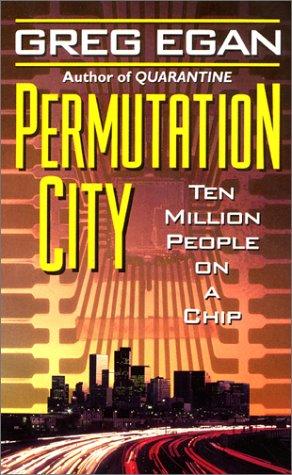
I need to say upfront that this book made me spend more time reading forum threads and Wikipedia articles about consciousness and computation than I spent reading the book itself, and I mean that as praise, though I understand it won’t sound like praise to everyone. Permutation City starts from a premise that’s now familiar enough to feel almost quaint, human minds scanned and run as software “Copies,” but Egan isn’t interested in the familiar version of that idea, he’s interested in following it to its most uncomfortable logical endpoint and then past that endpoint into something genuinely stranger.
The first half is the stronger half, and most people who’ve read this agree: Maria Deluca, an artificial-life researcher barely scraping by, gets pulled into Paul Durham’s scheme to make computing resources for these digital Copies functionally limitless, and the questions Egan raises here are the practical, unglamorous kind that most mind-uploading fiction skips past. Copies experience “slowdown” when real-world demand for processing power spikes. A wealthy Copy can outbid a poor one for the compute cycles that let them think and move at a normal subjective speed. Immortality, it turns out, is still rationed.
Then the book pivots into what’s usually called Dust Theory, and this is where opinion splits hard and where I landed somewhere in the middle myself. The idea, without spoiling the mechanics, is that a self-consistent pattern of computation doesn’t actually need continuous hardware running it, that consciousness might be less like a process and more like a mathematical object that simply exists, the way the number seven exists, whether or not anyone’s computing it. One reader called this “crazy talk” and said flatly they now know who to blame for the idea whenever it comes up elsewhere in fandom discourse, and I laughed at that because I understand the frustration completely even though the idea also, genuinely, keeps me up at night in the way good hard SF is supposed to.
Egan gets criticized constantly, and not unfairly, for character work that’s thin next to the idea-density, Riemann’s guilt arc in particular gets flagged as the weak link even by people who love the book. I don’t think that’s really a bug so much as a stated priority, Egan isn’t writing emotional soap opera dressed as science fiction, he’s writing philosophy of mind dressed as a thriller, and the characters exist mainly as vehicles for encountering the ideas rather than as the point of the exercise themselves. If you need deep interiority from your protagonists, this will read thin. If you came for a serious, load-bearing argument about what a self even is once you can copy it, this delivers more of that per page than almost anything else I’ve read.
Where I do agree with the harsher reviews is the ending’s ability to actually sell you on how the title’s virtual utopia, the “autoverse” city itself, gets constructed and sustained, it’s the one place where the book’s rigor loosens and asks you to just go with it. Four stars, not five, for exactly that reason, a book this committed to working out its premise rigorously owes you a rigorous landing, and this one wobbles a little at the very end. Still one of the smartest, strangest things I’ve read this year, and one I suspect I’ll be arguing with myself about for a long time after.