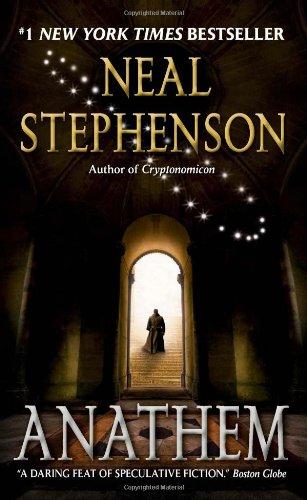
Okay so full disclosure, I bounced off this book twice before it stuck, and both times it was the same wall everyone hits, somewhere around page one-fifty when you realize Stephenson is not going to translate “fraa” and “sur” and “concent” for you, you’re just going to have to sit with it until it clicks. i went in a third time on audio, mostly out of stubbornness, and something about hearing the invented words instead of tripping over them on the page made the whole thing go down easier.
The premise, stripped of the vocabulary: a walled-off scholarly caste on another planet, cut off from the secular world for years or decades or centuries depending on which order you belong to, gets pulled back into that world when something shows up in orbit that nobody invented and nobody can explain. That’s it, that’s the engine. What Stephenson spends the first act doing instead of telling you that is building out a monastic clockwork bureaucracy in more architectural and procedural detail than the plot strictly needs, fifteen pages on a clock tower at one point, and I get why people call that self-indulgent, because it kind of is.
But here’s the thing nobody tells you going in, and it’s the detail that actually got named more than once buried in a stack of reviews rather than in the loud consensus: this is basically A Canticle for Leibowitz with the serial numbers filed off and about four hundred more pages of thought experiment stapled on, and once you clock that lineage the slow monastery stuff stops feeling like padding and starts feeling like the point. One reader called it “Harry Potter for the logically-inclined,” which is funny and also not wrong, the magic here is just rigor.
Where it lost me a little, and where I think it loses a lot of people honestly, is the made-up-word density outlasting its welcome. Calling technology “praxis” and insight “up sight” doesn’t do any real work that a glossary note couldn’t have done in a tenth the space, it’s obfuscation dressed as worldbuilding, and there’s a whole current of readers who clocked that as a bug rather than a feature. I don’t disagree, but I also didn’t mind it as much as I expected to, because once the ship arrives and Erasmas gets pulled out past the walls the book stops circling itself and starts moving.
The back third is genuinely a different book, faster, colder, more interested in cosmology and consciousness and multiple-worlds physics than in monastery politics, and Stephenson’s trademark thing of dumping twenty pages of theory into the middle of an action sequence is fully present and I happen to like it, your mileage may vary depending on how much math you want in your escape velocity. There’s a version of this book, someone pointed out, that puts all the deep-dive appendix material in an actual appendix the way Tolkien did with the elf songs, and honestly, yeah, that book might be better paced. This one asks you to read the appendix mid-scene.
Four stars, not five, because the ending is doing a lot of lifting for a book that took nine hundred pages to get there, and because I think you have to actually want this kind of intellectual endurance test going in, it will not convert someone who isn’t already curious about quantum multiverse theory dressed up as adventure fiction. But if you’re the kind of reader who daydreams afterward about a world built around devoting your whole life to a Big Problem with people who take it as seriously as you do, this one stays with you longer than its page count has any right to.