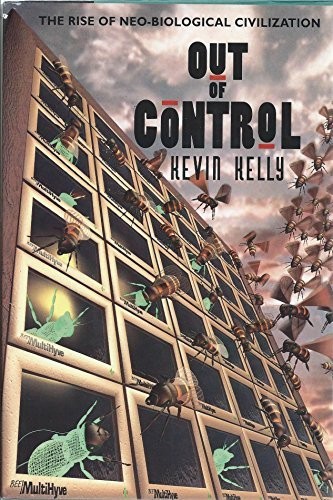
Another non-fiction detour, this one from 1994, which shows in places, but the core idea has aged better than I expected going in. Kevin Kelly’s project here is to walk through a huge range of complex, self-organizing systems, beehives, ecosystems, mob behavior, artificial evolution, and show that the same underlying logic keeps showing up regardless of whether you’re looking at biology or crowds or early digital networks: real intelligence and real order can emerge from a pile of dumb, uncoordinated parts, with nobody in charge and no single part understanding the whole.
The beehive example is the one that stuck with me hardest, and apparently I’m not alone, more than one reader singled it out specifically. Before this book I thought of a hive as a bunch of simple drones running on instinct. Kelly walks through how the hive as a whole behaves like a single organism making decisions no individual bee is capable of, and once you see that framing you can’t quite unsee it, it changes how you look at a crowd, a stock market, a flock of birds turning in unison. He does something similar with human mobs, showing how coordinated group behavior can emerge without anyone actually directing it, which is a genuinely useful lens for understanding a lot of things that otherwise look mysterious.
The style is unusual for this kind of book, more lyrical and journalistic than academic, which some readers appreciate as a relief from dry textbook prose and others read as a symptom of Kelly being a journalist rather than a scientist, prone to generalizations that a specialist would hedge much harder. I land somewhere in between. The writing carries you along nicely, sometimes almost like poetry given how dense the subject matter actually is, but there were stretches, particularly a long list-like passage cataloguing dozens of concepts, autocatalysts, saltation, net math, stable instability, one after another, where it felt more like an inventory than an argument.
The dated parts are exactly what you’d expect from a book about “cutting edge” technology and complexity theory written thirty years ago: some of the specific technological speculation reads quaint now, and the chapters occasionally feel disconnected from each other, which cost it real engagement for at least one reader who gave up around the halfway mark. I didn’t give up, but I did find myself more engaged by the biological chapters than by the later ones reaching toward digital systems, which is a strange thing to say about a book partly remembered as an early, prescient text on network thinking.
Four stars. Not a perfect book, and not one to read for its specific technological predictions, several of which have simply been overtaken by what actually happened since. But the underlying argument, that autonomy and adaptability and real “moreness” can emerge from systems nobody is steering, including the systems we build, is one I keep returning to since finishing it, in contexts that have nothing to do with beehives at all.